

Long layers are the quiet workhorse of haircuts: they add movement and shape without sacrificing an inch of length. This year, the trend leans toward soft, blended layers that work with your natural texture rather than against it.
These 19 Long Layers Haircut Ideas cover the full spectrum, from collarbone-length cuts with curtain bangs to mid-back styles with face-framing pieces. If your fine hair tends to fall flat by midday or your grow-out line shows up too fast, there is something here that solves that exact problem. The range suits straight, wavy, and curly textures alike.
Collarbone Length Long Layers With Curtain Bangs
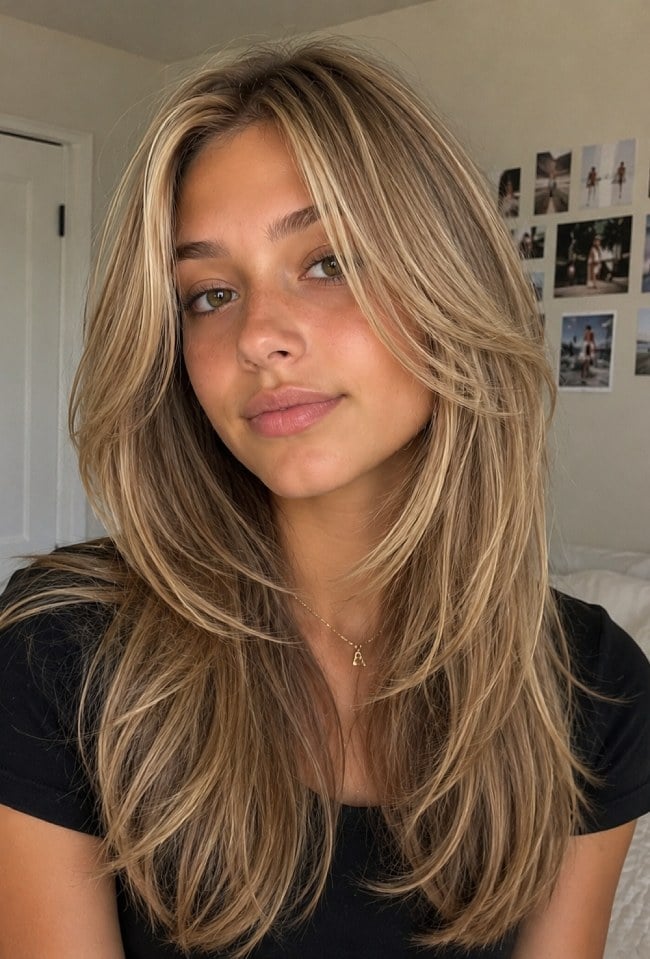
A collarbone-to-shoulder cut with curtain bangs and face-framing layers creates a shape that moves rather than sits still. The middle part and honey beige blonde highlights over a light brown base give the soft waves something to catch the eye. Ask your stylist for: collarbone layers with curtain bangs, soft waves. Medium density wavy hair starting at collarbone length holds this best, and the curtain bangs soften round and square faces. Blow-dry the bangs with a round brush to encourage the curve, and plan on a trim every eight to ten weeks to keep the layers from turning into one solid block.
Mid-Back Long Layers With Side Part
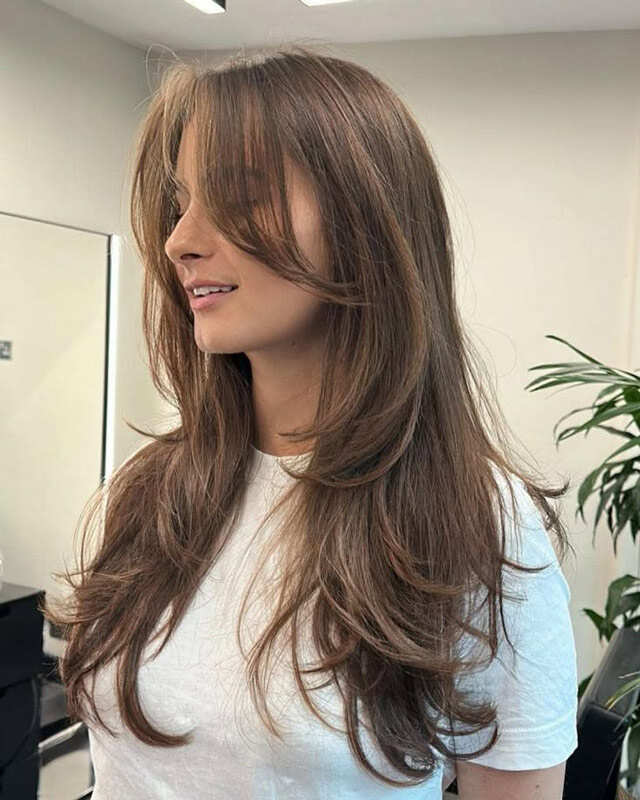
A side part changes how long layers behave. On mid-back length hair with curtain bangs and face-framing pieces, the deeper part directs the layers to fall more heavily on one side, which adds volume where it can do the most good for longer face shapes. The medium brown base with subtle highlights gives the wavy, thick texture enough dimension that the blowout does not look flat by the end of the day.
Ask your stylist for: mid-back layers, face-framing cut, curtain bangs, side part. Thick wavy hair at mid-back length handles the weight removal without losing body. Use a large round brush for the blowout to emphasize the layers, and book a trim every six to eight weeks to keep the baseline crisp rather than ragged.
Collarbone Layers With Face Framing And Side Part
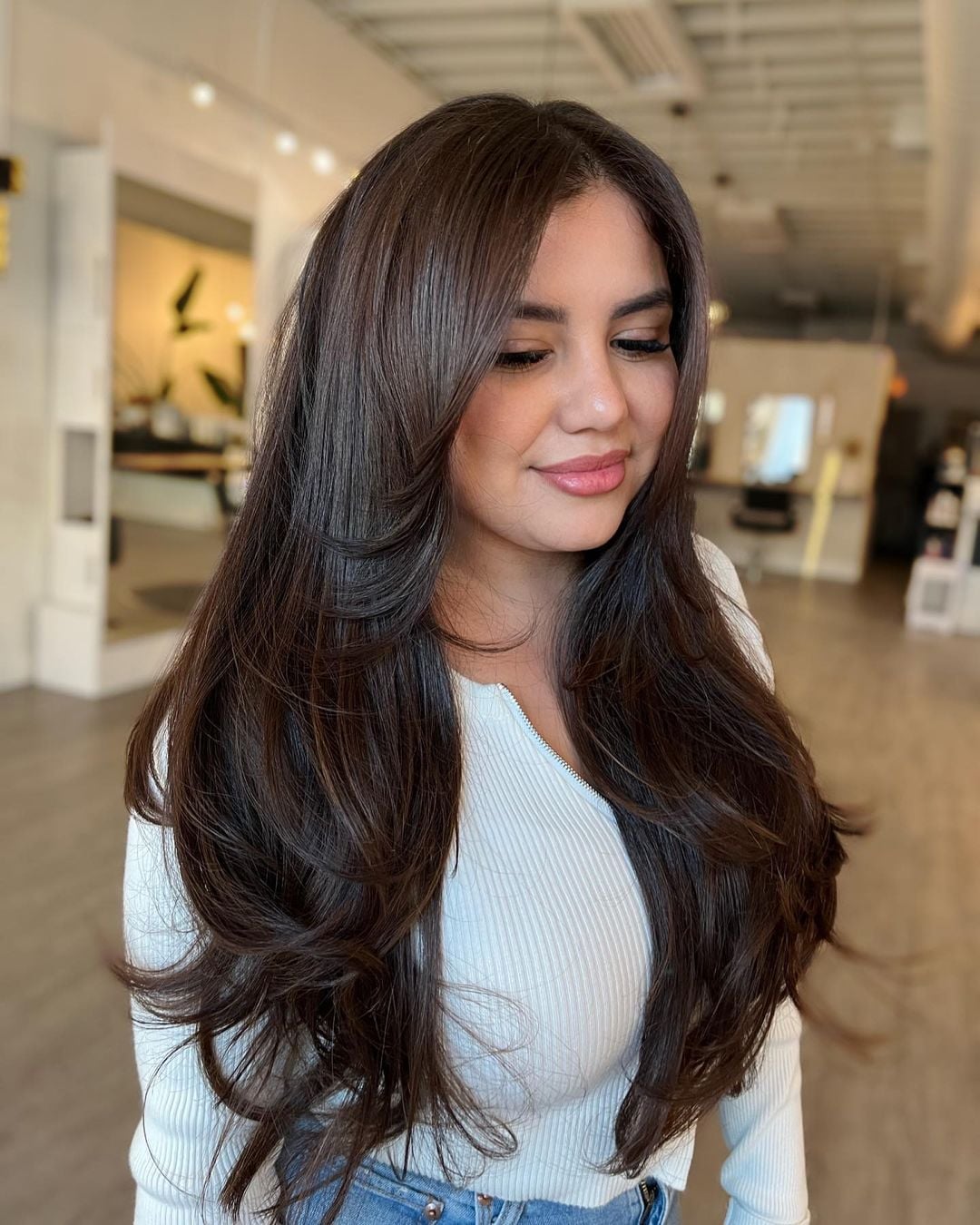
Thick wavy hair can feel heavy when it is all one length. Collarbone layers with face-framing pieces and curtain bangs remove bulk where it matters most, around the jawline, while keeping density through the lower section. The side parting adds lift at the root, and the dark brown base with subtle highlights prevents the cut from reading as flat.
Ask your stylist for: collarbone length layers, face-framing cut, curtain bangs, side part. This cut suits thick wavy hair that needs weight reduction without losing overall length. The face-framing layers shorten the visual distance from chin to collarbone, which softens square and angular jawlines.
Collarbone To Shoulder Layers With Blowout
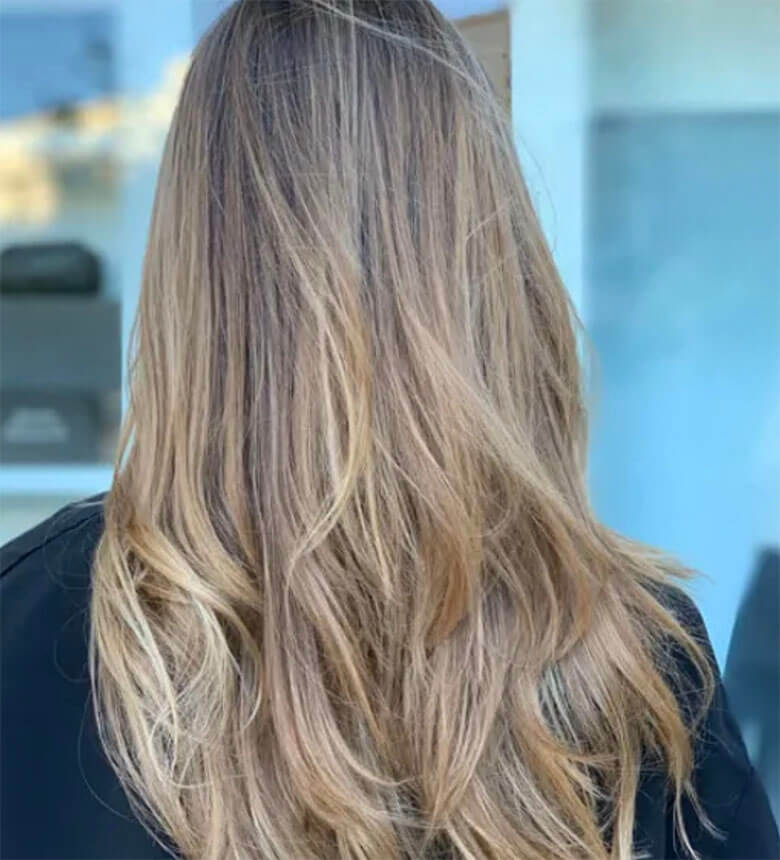
Face-framing pieces that blend into longer lengths require the stylist to cut the shortest layer at the cheekbone and angle each subsequent layer down toward the collarbone. The result is a graduated curve that tucks behind the ear or swings forward depending on how you dry it. The mid-back length overall keeps the weight low, while the dark brown base with subtle highlights gives the wavy texture enough contrast to show the layers clearly.
Ask your stylist for: collarbone to shoulder layers, curtain bangs, soft waves. Thick wavy hair starting at collarbone length holds this shape best. The face-framing pieces should be cut dry so the stylist can see how your natural wave falls, and the blowout should direct the root forward at the temples to avoid a flat line.
Collarbone Layers With Balayage For Fine Hair

Fine wavy hair and long layers have a tricky relationship. Too much internal layering and the ends look sparse; too little and the hair hangs without movement. The answer is a collarbone length cut with face-framing layers and curtain bangs, paired with a medium brown balayage that adds visual density through the mid-lengths. The side parting gives a lift that fine roots do not naturally provide. Ask your stylist for: collarbone layers, face-framing cut, curtain bangs, balayage, fine hair. Fine hair needs a volumizing mousse at the roots before blow-drying, or the layers collapse into each other by noon.
Collarbone Straight Layers With No Bangs
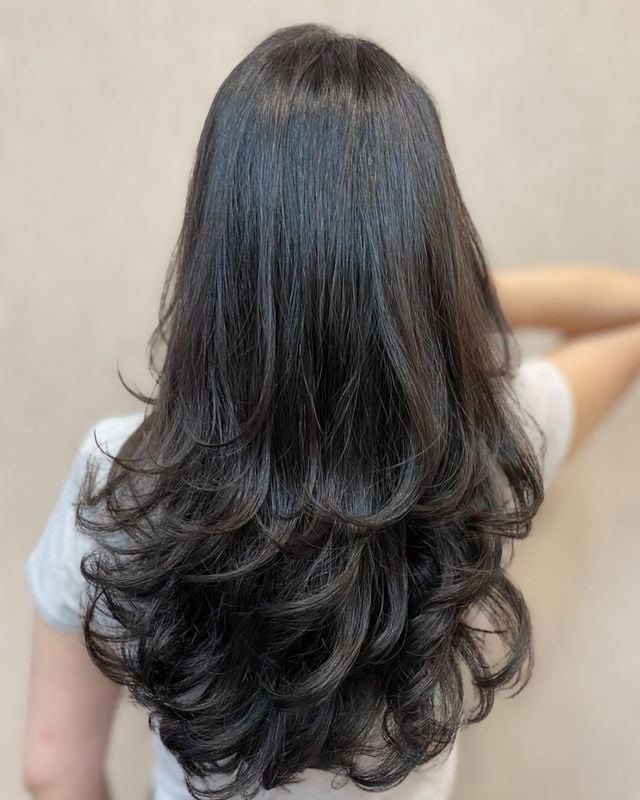
A collarbone cut with long layers removes bulk from thick hair without reducing density. This suits straight, thick textures that can handle a middle part without looking flat. Skip the bangs entirely and let the smooth blowout do the work. Ask your stylist for: collarbone length straight layers, no bangs. A boar bristle brush gets you a polished finish at home, though the initial shape is best cut in the salon. Trimming every eight to ten weeks keeps the ends clean. Compare this to a style with curtain bangs: the no-bangs version needs less daily styling and grows out more gracefully, but it also lacks the softening effect that fringe provides.
Shoulder To Collarbone Air Dried Waves With Bangs

Does air-dried hair look deliberate enough for a cut with layers? It does when curtain bangs are part of the plan. The shoulder-to-collarbone length with long layers lets medium-density wavy hair fall into soft shape without a round brush. Ask your stylist for: shoulder to collarbone layers, air dried waves, curtain bangs. A curl cream applied to damp hair and left alone is the whole routine. This lands best in warmer months when a blow-dryer feels like a punishment. The subtle lighter pieces add dimension as the waves set.
Mid-Back Layers With Blonde Balayage

The dark brown base with blonde balayage creates contrast that softens the line between sections. Ask your stylist for: mid-back layers, long flowing layers, blonde balayage, side part. The lighter pieces are painted on, so the root line grows out gradually and does not announce itself at week three. Thick, wavy hair holds the soft-wave shape best; fine hair may need a texturizing spray to keep the layers visible. A trim every eight to ten weeks maintains the shape. The side part adds volume on the fuller side, which helps the balayage appear deliberate.
Mid-Back Dark Chocolate With Curtain Bangs

Then add the cut: mid-back length with long layers and face-framing pieces that blend into curtain bangs. The bangs are the key detail, ask for them to start at the cheekbone and angle outward. Ask your stylist for: mid-back dark chocolate, curtain bangs, face-framing layers. A medium round brush on the bangs and a smoothing serum on the rest give the blowout its shine. The thick wavy texture holds the waves without product. This is an all-salon job; the bangs need precision that home scissors cannot deliver.
Mid-Back Layers With See-Through Bangs
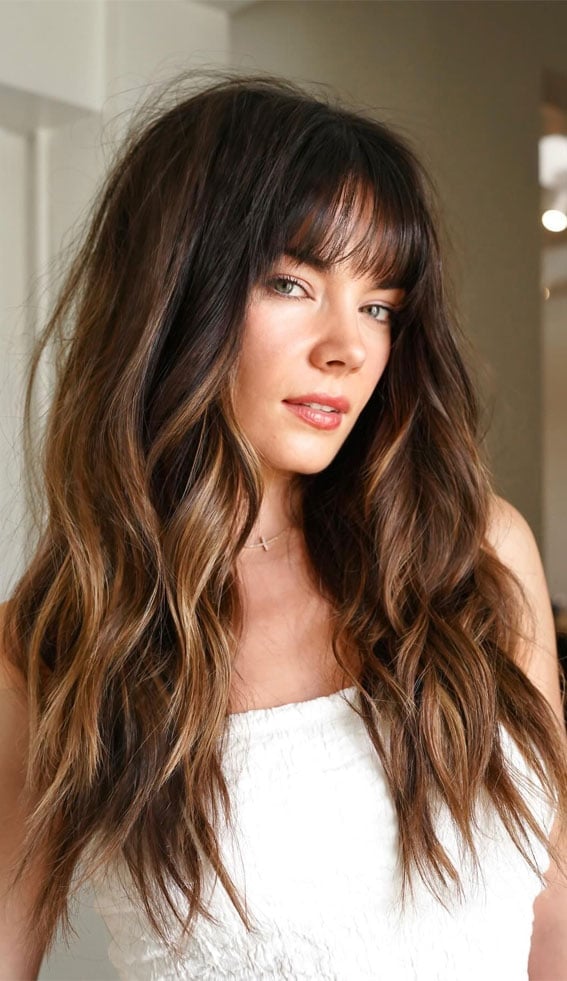
The construction is straightforward: long layers throughout the mid-back length, with see-through bangs cut to reveal the forehead. The bangs are point-cut to remove weight, creating a wispy edge that separates them from a solid fringe. Ask your stylist for: mid-back layers, caramel highlights, see-through bangs. The caramel pieces lighten the dark brown base without a full balayage commitment. The bangs are the technical part. They need dry cutting and a light hand to avoid turning into a blunt line. A middle part keeps the rest of the layers symmetrical. Thick wavy texture holds the shape; the bangs should be styled with a flat iron on low heat for that separated look.
Mid-Back Voluminous Curls With Face Framing
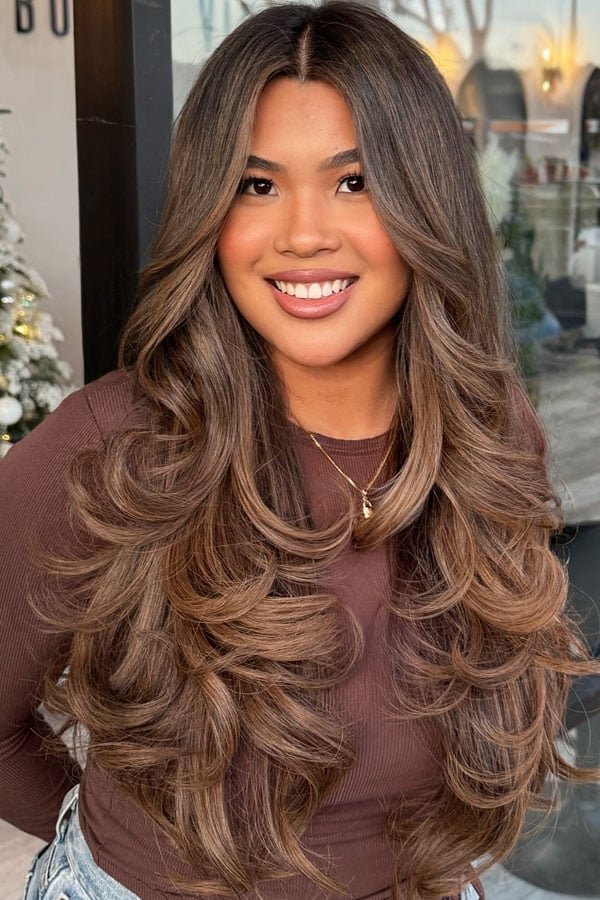
Voluminous curls at mid-back length rely on long layers cut precisely to keep the weight below the shoulder, not piled at the crown. The face-framing pieces here are cut shorter than the rest, so they curl forward instead of disappearing into the mass, a key detail for thick wavy hair. A middle part splits the volume evenly, and the subtle lighter highlights catch the curve of each wave. Ask your stylist for: mid-back voluminous curls, face-framing layers, middle part.
This cut suits thick wavy textures that can support the bounce without the layers turning into a pyramid. If your curl pattern is tighter or your density is low, the face-framing pieces may look sparse. A diffuser on low heat and a curl-defining cream are standard tools here; a trim every 10 to 12 weeks keeps the shape from losing its spring.
Mid-Back Copper Red With Voluminous Waves
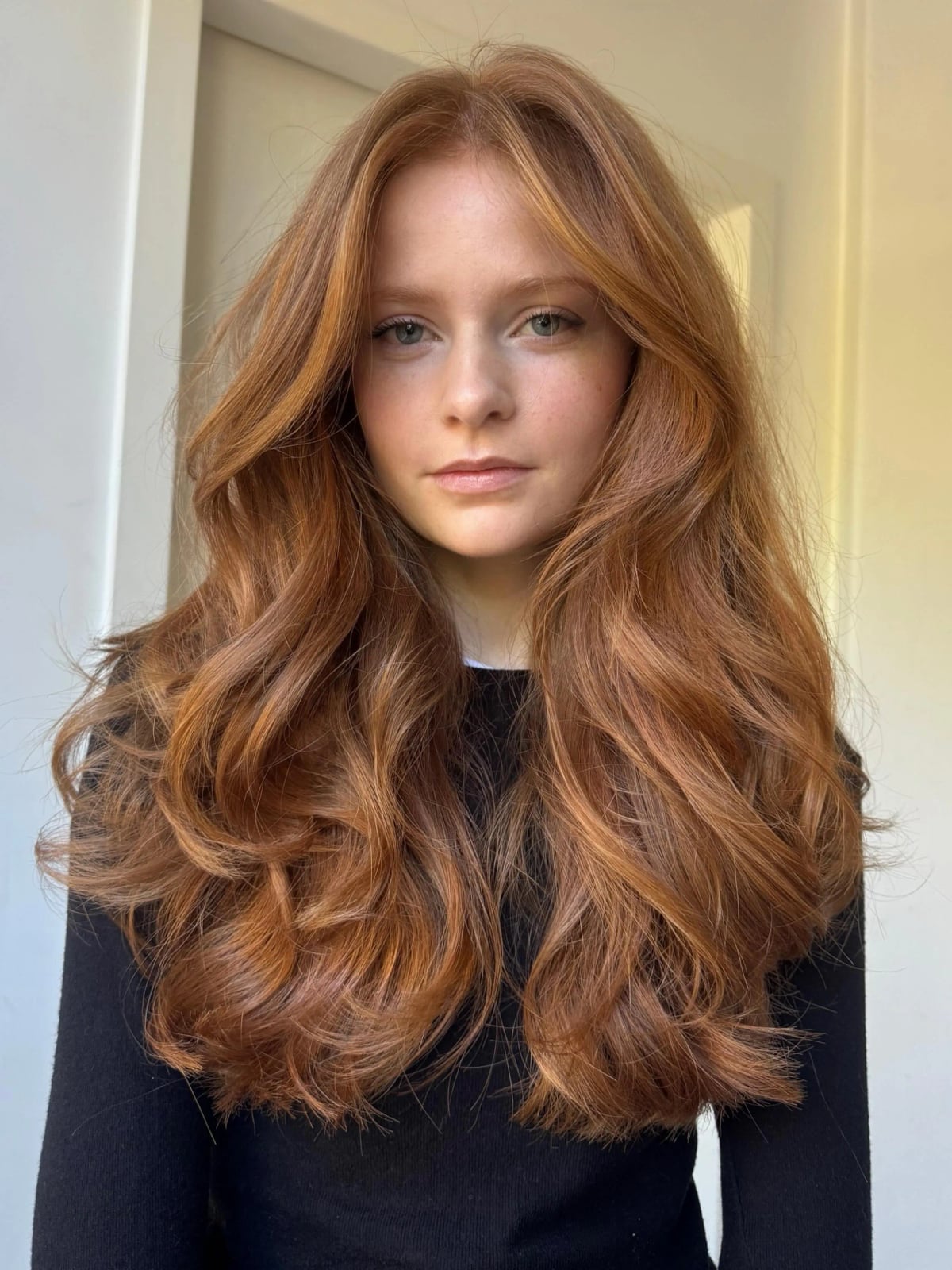
Copper red is not auburn and it is not strawberry blonde, it is a straight-up orange-red that lands somewhere between a fire escape and a new penny. On mid-back length with long layers, the color is a statement, especially with a middle parting that lets the wave pattern break evenly on both sides. The loose voluminous waves here are not tight ringlets, they are wide curves that show the vibrancy of the color from root to end. Ask your stylist for: mid-back length, vibrant copper red, voluminous waves, long layers.
This is a seasonal choice that works best when the light is lower, fall through early spring, because the shade competes with high-summer brightness. Thick wavy hair holds the wave longer than fine straight hair, which matters because copper red fades faster than brown and needs a color-depositing shampoo every four to six weeks to stay loud.
Mid-Back Layers With Wispy Bangs
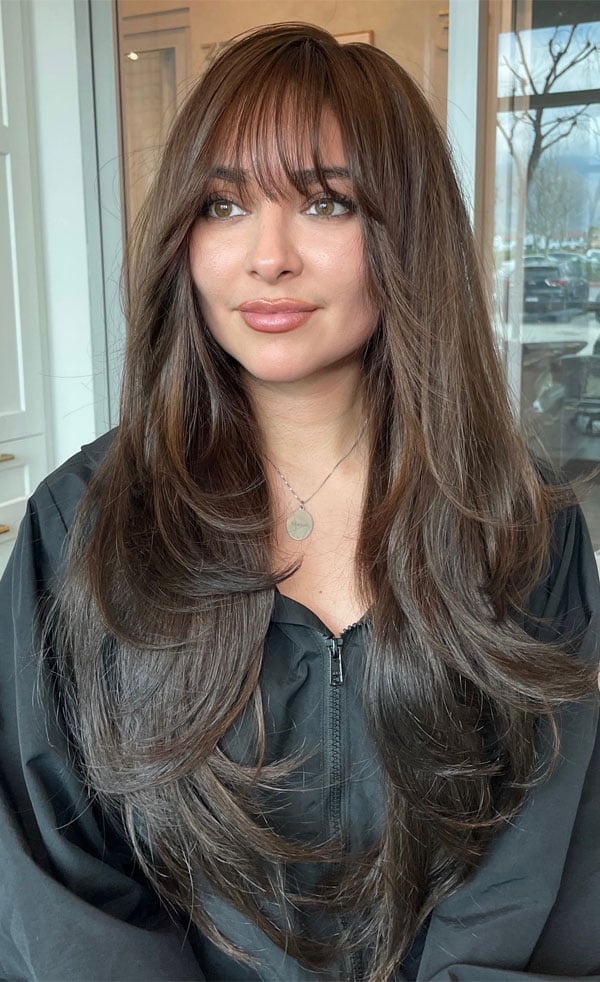
Wispy bangs on thick wavy hair are a negotiation: the hair gets a voluminous blowout, but those front pieces need separate attention to stay light and separated instead of clumping into one heavy curtain. The long layers here start below the ear and build volume through the mid-back length, while the wispy bangs are cut short enough to clear the brow but long enough to merge with the sides. A middle parting anchors the symmetry. Ask your stylist for: mid-back layers, wispy bangs, voluminous blowout.
Mid-Back Thick Hair With Long Layers
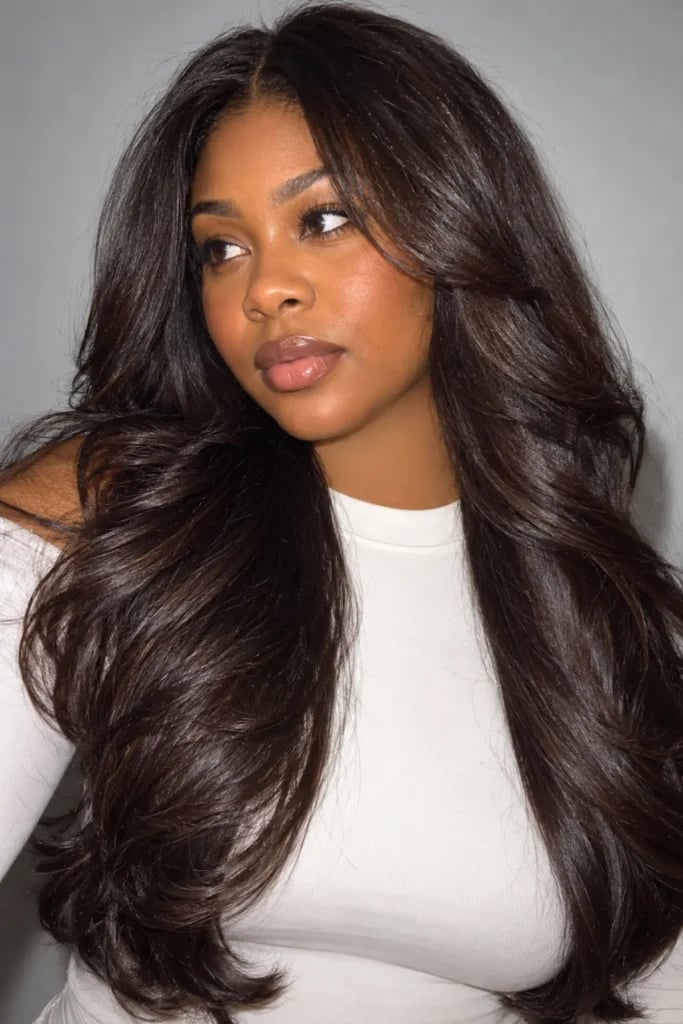
Thick hair at mid-back length without layers is a triangle waiting to happen, so the long layers here are cut to remove weight from the interior while keeping the perimeter full. The side part breaks up the bulk on top, and the soft waves add curve without requiring a full curl set every day. The dark brown base with subtle highlights prevents the mass from reading as one solid block. Ask your stylist for: mid-back length, long layers for thick hair, no bangs.
Daily styling for this cut is about ten minutes with a round brush and a blow-dryer, focusing on the roots to stop the weight from pulling the waves flat. A volumizing mousse at the roots helps, but the real work is the trim schedule: every eight to ten weeks, or the layers grow out and the triangle returns. The side part can be switched to the opposite side for a quick volume shift on day two.
Mid-Back Straight Layers With Subtle Movement

For straight thick hair, internal layers are cut shorter underneath the top length, so the hair moves without visible chunks or disconnected ends. Here the mid-back length stays dense at the hemline, but the internal layers create soft bends when the blowout directs the hair forward and back instead of straight down. The middle part keeps the weight balanced. Ask your stylist for: mid-back straight layers, internal layers, dark brown.
The technique avoids the stair-step look that happens when layers are cut too blunt on straight hair. A paddle brush and a heat protectant are standard for the blowout, and the movement shows best when the hair is fully dry and smooth instead of air-dried. Trims every eight to ten weeks maintain the internal structure; without them, the subtle movement becomes just straight hair with split ends.
Mid-Back Air Dried Waves With Natural Texture
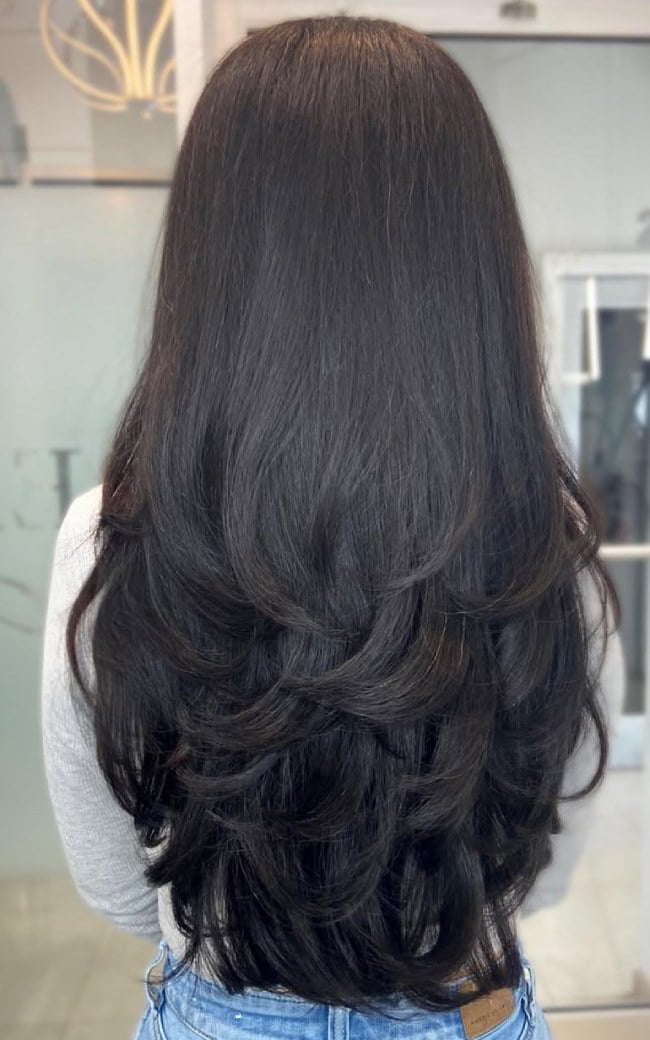
This cut works with your wave pattern, not against it. Ask your stylist for: mid-back length, long layers, air dried waves, natural texture, no bangs. Thick wavy hair at mid-back length benefits from the reduced heat damage that comes with skipping the dryer entirely. Apply a sea salt spray to damp hair, then let it dry naturally. A trim every 10 to 12 weeks keeps the ends from fraying. You need decent wave memory to begin with: straightish hair will look flat, not lived-in.
Mid-Back Dark Brown With Face Framing Layers
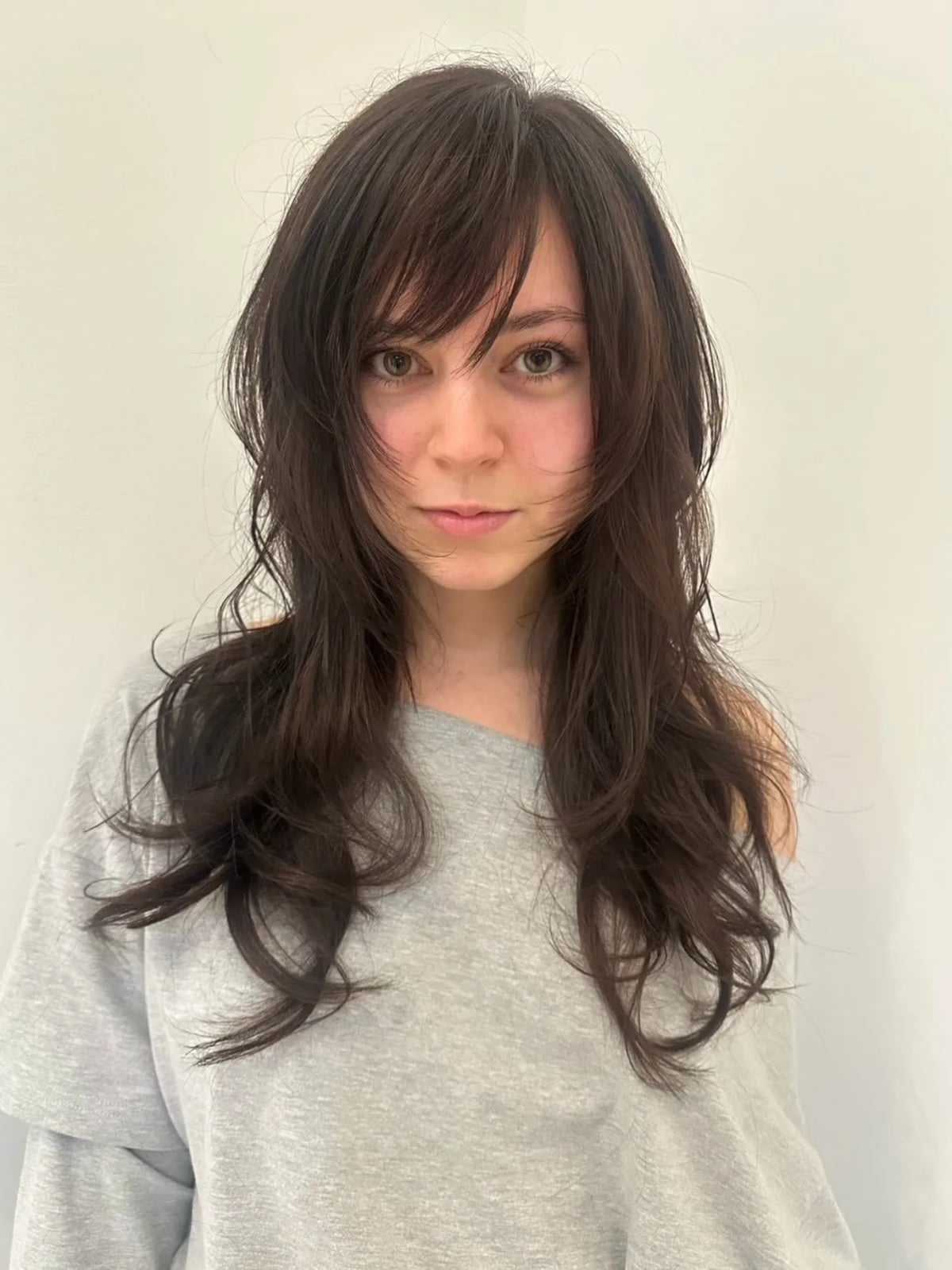
Face-framing layers soften the edges of a one-length cut without committing to full bangs. On mid-back dark brown hair with a thick, wavy texture, the layers land around the jaw and collarbone, creating a gentle frame that moves with you. It is a middle ground between a blunt cut and a heavily layered shag: you get shape at the front and weight at the back.
Ask your stylist for: mid-back length, face-framing layers, air dried style. A texturizing cream worked into damp hair and scrunched gives the waves definition without crunch. If your hair is on the finer side, skip the cream and use a volumizing mousse instead. A trim every 8 to 10 weeks keeps the face-framing pieces from losing their intended shape.
Mid-Back Wavy Strawberry Blonde With Layers
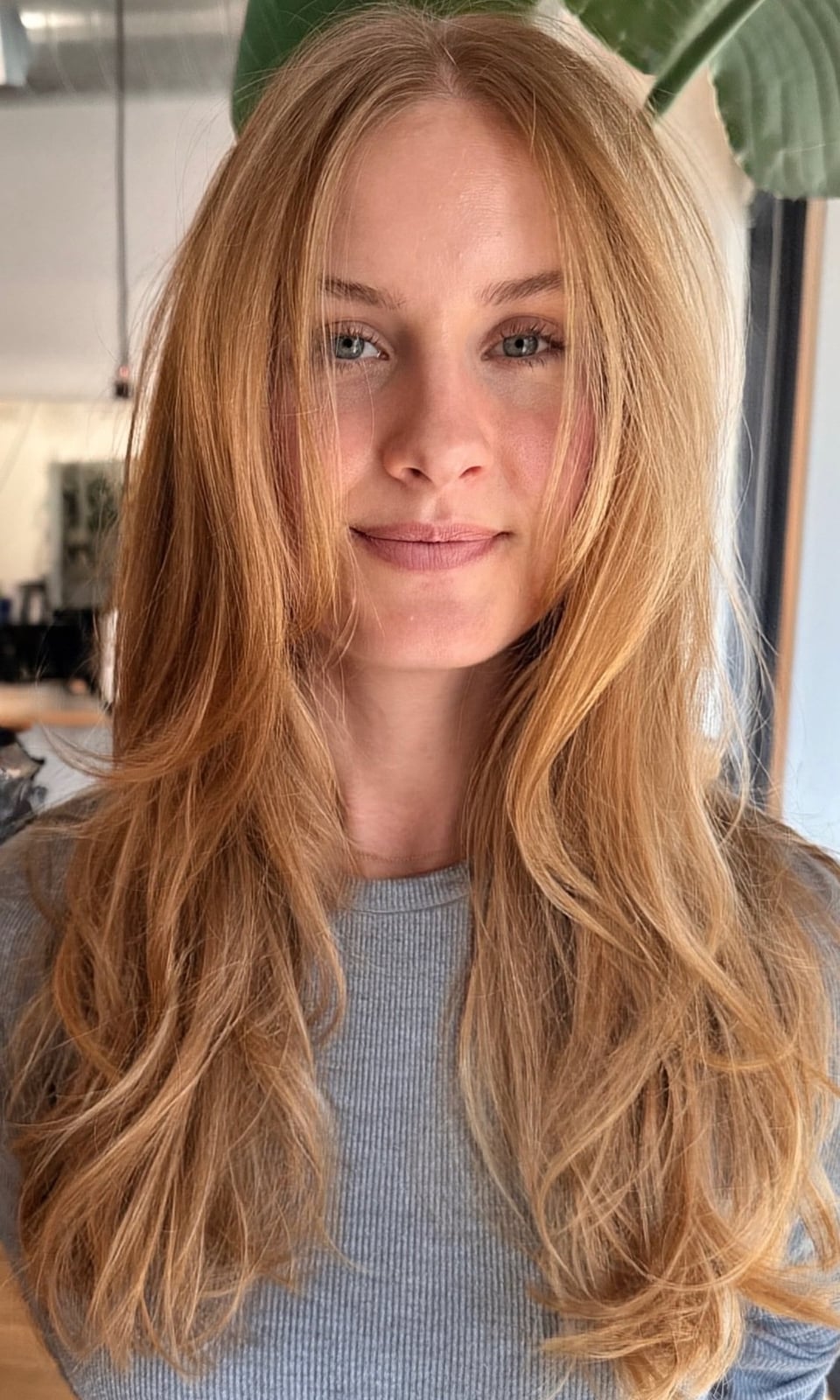
Strawberry blonde works best on hair with natural warmth, since the color needs a golden undertone to look peachy and not brassy. Here, mid-back length medium-textured waves carry the shade with subtle layers that add volume without removing density. No bangs keeps the look open and low-maintenance, which matters when the color already demands toning every four to six weeks.
Ask your stylist for: mid-back length, subtle layers, wavy strawberry blonde. Use a curl-enhancing product on damp hair and diffuse or air dry. This cut skips the curtain bangs and the heavy face-framing, so the layers stay hidden until the hair moves. Medium density is the sweet spot: fine hair might look stringy, while very thick hair could feel bulky at this length.
Mid-Back Black With Teal Highlights And Layers

This is not a set-it-and-forget-it color. Black hair with vibrant teal highlights requires a double process to lift the base, then deposit the teal, and the contrast is what makes it work. On thick, wavy mid-back hair with curtain bangs, the long layers let the teal pieces peek through without overpowering the black base. Ask your stylist for: mid-back length, black hair, vibrant teal highlights, long layers. The honest drawback is that teal fades to a greenish pastel within four to six weeks and needs a color-depositing conditioner or a toner to stay bright. A glossing treatment at the salon every other visit helps the black base stay rich. Trim every 8 to 10 weeks to keep the shape clean, since damaged ends show faster on lightened sections.
Final Thoughts
For fine hair, keep one blunt baseline and skip heavy internal layers so the ends still look dense. For thick hair, ask for internal layering to remove bulk while the outer length stays long. Long layers offer a timeless way to refresh your look.
- Trim every 8-12 weeks to maintain layer shape.
- Use a heat protectant spray before blow-drying or heat styling.
- Toning may be needed every 6-10 weeks for highlighted colors.
- Apply a texturizing spray or sea salt spray for enhanced waves.
- Wash hair 2-3 times a week to preserve color and natural oils.
